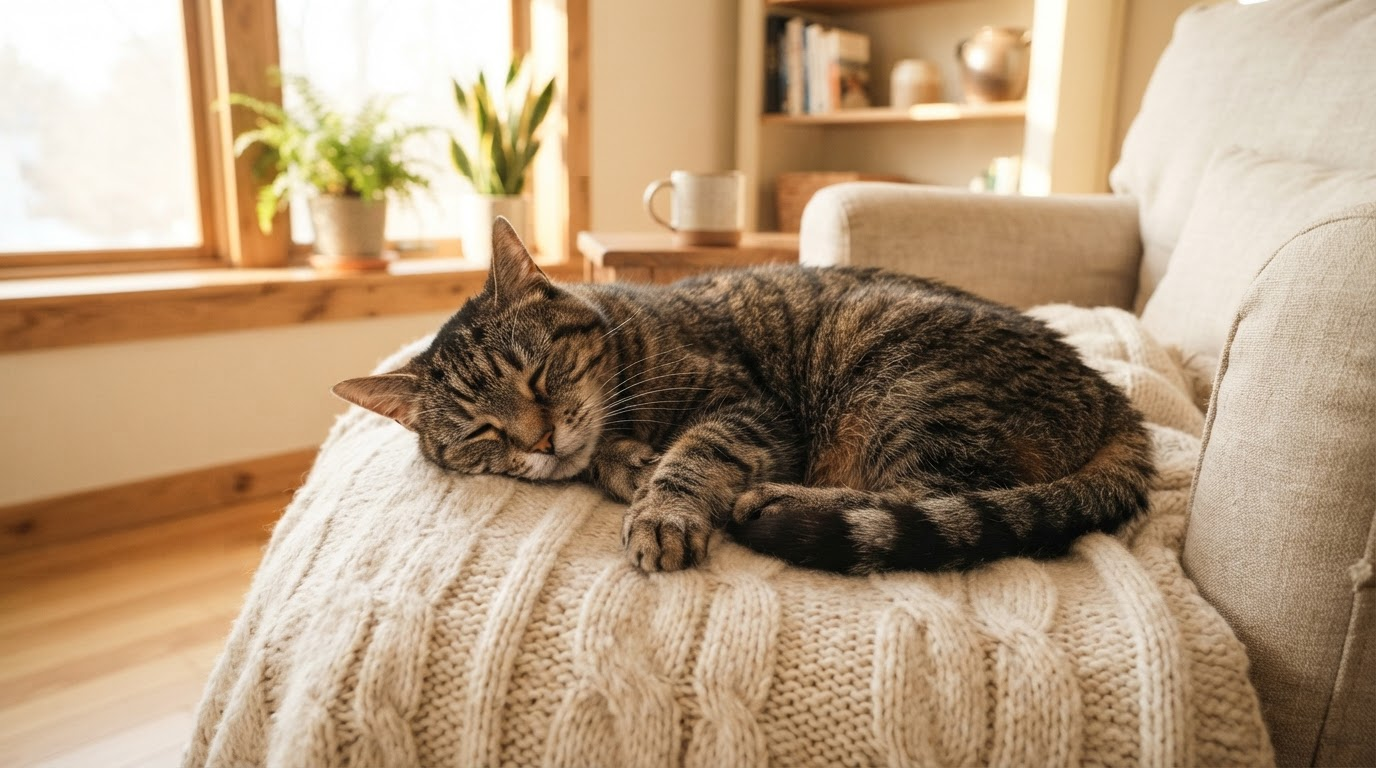
What Is Arthritis in Cats?
Arthritis, commonly called osteoarthritis or degenerative joint disease, develops when the structures inside a joint gradually deteriorate.
Healthy cartilage helps bones move smoothly against one another. As the joint becomes damaged, inflammation, stiffness and pain may develop. The condition is progressive, meaning that it generally cannot be reversed, although its symptoms can often be controlled.
Age is a major risk factor, but arthritis is not restricted to very old cats. Previous injuries, abnormal joint development and other orthopedic problems may also contribute.
One important distinction is that joint changes on an X-ray and clinical arthritis pain are not exactly the same thing. A veterinarian considers the cat's behavior, mobility, physical examination and imaging findings together rather than relying on an X-ray alone.
Happy Senior Pet Tip
Keep a tiny notebook by your cat's favorite sunny spot. One line a day — "chose floor bed, skipped windowsill" — shows patterns you might otherwise miss. After a week, those notes become a story your vet can actually use.
Signs and Symptoms of Arthritis in Senior Cats
Cats with arthritis do not always limp. Instead, owners are more likely to notice changes in normal behavior and movement.
Possible signs include:
- Jumping less often or choosing lower surfaces
- Hesitating before jumping up or down
- Difficulty climbing or descending stairs
- Moving slowly or appearing stiff after resting
- Sleeping more or becoming less active
- No longer using a favorite high perch
- Struggling to enter a high-sided litter box
- Urinating or defecating outside the litter box
- Grooming less, particularly around the back and hindquarters
- Developing matted or greasy fur
- Hiding or interacting less with the family
- Becoming irritable when picked up or touched
- Playing or running less frequently
Pain can also cause defensive behavior. A cat may hiss, scratch or try to escape when a painful area is handled.[2]
Vet Tip
These signs can also occur with kidney disease, dental pain, neurological conditions, muscle loss and other illnesses common in older cats. A veterinary examination is therefore important before assuming arthritis is responsible.
Happy Senior Pet Tip
If jumping has become hard, move your cat's favorite blanket to a lower, warm resting place. Cats don't always pick lower spots because they love them more — they're just easier. Making the easy spot feel loved matters.
Videos can help your veterinarian
Cats may move differently at home than they do inside a veterinary clinic. Recording short videos of your cat walking, climbing stairs, entering the litter box or jumping onto a familiar surface can give the veterinary team useful information.
Current senior-care guidance recognizes owner observations, home videos and structured pain questionnaires as valuable tools for identifying and monitoring mobility problems.[3]
Happy Senior Pet Tip
Try to keep food, water, and the litter box on the same floor, especially overnight. If you have stairs, a second water bowl on the other level means less unnecessary climbing when joints are stiffest and coldest.
What owners often notice first
Lower choices
Choosing the sofa edge over the high shelf
Hesitation
Pausing before a jump or stairs
Quiet withdrawal
Less grooming, more hiding, easier irritation
Comparing changes • educational only
Normal Aging or Arthritis? Understanding the Difference
While some slowing down can occur with age, certain changes are more suggestive of arthritis and deserve a veterinary evaluation.
These signs do not confirm arthritis. Many medical conditions can cause similar changes. If you notice persistent changes in your cat's behavior or mobility, schedule a veterinary examination.
When Should You See a Veterinarian?
Arrange an appointment when you notice persistent changes in your cat's movement, grooming, litter-box habits, appetite, activity or personality.
Seek veterinary advice promptly when your cat:
- Suddenly cannot walk or support its weight
- Appears severely painful
- Stops eating
- Cries out during movement
- Has a swollen joint
- Develops sudden weakness or paralysis
- Has difficulty urinating
- Experiences a rapid or unexplained behavioral change
A veterinarian may review your cat's medical history, observe its movement and carefully examine its joints and muscles. Blood and urine testing may be recommended, particularly before certain medications are prescribed or when another illness could be contributing to the symptoms.
Happy Senior Pet Tip
Record short 15-second videos every few weeks from the same angle — walking to the bowl, stepping into the box. It's gentler than trying to remember details, and watching them side-by-side helps you notice slow changes you'd miss day to day.
Diagnosis
Radiographs may reveal degenerative changes and help rule out fractures, tumors or other orthopedic problems. However, the diagnosis and treatment plan should reflect the whole cat—not only the image.
Vet Tip
How Is Arthritis in Cats Treated?
Arthritis management is usually multimodal. This means combining several approaches that address pain, mobility, weight, environment and quality of life.
Pain-management guidance from AAHA and the Feline Veterinary Medical Association emphasizes ongoing assessment and individualized treatment rather than a single universal solution.[3]
Vet Tip
The most appropriate plan depends on factors such as:
- The severity of the cat's pain
- Kidney, liver and gastrointestinal health
- Other medications
- Body weight and muscle condition
- Ability to receive oral medication
- Response to previous treatments
- The owner's ability to administer and monitor treatment
Happy Senior Pet Tip
Create a calm little ritual around care time — same quiet corner, a soft towel already laid out, favorite treat after. Cats feel safer when care is predictable, not sudden. You'll both breathe easier.
Safety warning
Never give a cat ibuprofen, acetaminophen, aspirin, or any other human pain medication unless a veterinarian has specifically prescribed that exact medication and dose.
Solensia
Solensia is the brand name for frunevetmab, a monoclonal antibody approved by the US Food and Drug Administration for controlling pain associated with osteoarthritis in cats.
It works by targeting nerve growth factor, a protein involved in transmitting osteoarthritis pain. The medication is given as an injection under the skin once a month.[4]
Solensia may be considered a first-line option for osteoarthritis-related pain, but it is not automatically right for every cat. A veterinarian should discuss the potential benefits, limitations and adverse reactions before treatment begins.
Reported reactions in the approval studies included gastrointestinal and skin-related problems, among others. Owners should contact their veterinarian if they notice vomiting, diarrhea, appetite changes, lethargy, skin irritation or any unusual symptoms after an injection.[5]
Adverse-event reports submitted after a drug reaches the market do not, by themselves, prove that the medication caused each reported event. They are nevertheless important safety signals for regulators and veterinarians to evaluate.[6]
Anti-inflammatory medications
Nonsteroidal anti-inflammatory drugs, or NSAIDs, can reduce inflammatory pain and may improve mobility. However, cats process these medications differently from humans and dogs.
In the United States, no NSAID is approved for the long-term treatment of chronic pain in cats. Certain medications, including meloxicam or robenacoxib, may sometimes be used under carefully selected circumstances and veterinary supervision, but approval and prescribing practices vary by country.[7]
Cats receiving an NSAID may require examination, laboratory testing and continued monitoring. Owners should never change the dosage or combine medications unless instructed by the veterinarian.
Vet Tip
Other pain medications
A veterinarian may sometimes include medications such as gabapentin as one component of the plan. The appropriate drug and dose depend on the individual cat and the type of pain being treated.
Medication should be reassessed over time. What works initially may require adjustment as the condition or the cat's general health changes.
How to Make Your Home Arthritis-Friendly
Environmental modifications are among the most practical ways to help a cat with painful joints. The aim is not to stop the cat from moving—it is to make necessary movement safer and easier.
Visual guide • teach, not just decorate
Making Your Home Easier for an Arthritic Cat
A calm, accessible layout reduces daily strain. Small adjustments in key areas support comfort and confidence.

Key areas shown above
Happy Senior Pet Tip
Place a sturdy non-slip mat in front of the litter box and food bowls. That extra grip under paws makes an unsteady moment feel secure, especially on tile or hardwood. It's a tiny change with a big comfort payoff.
Provide easier access to favorite places
Use stable ramps, pet steps or low furniture to create a gradual route to:
- Beds
- Sofas
- Windows
- Favorite chairs
- Cat trees
- Other preferred resting areas
Ensure that ramps and steps have a non-slip surface and cannot wobble.
Improve traction
Hardwood, laminate and tile can be difficult for a cat with weak or painful limbs.
Place secure, non-slip rugs, carpet runners or mats along frequently used routes. Pay particular attention to areas near:
- The litter box
- Food and water
- Stairs
- Beds
- Jumping and landing points
Avoid loose rugs that slide or bunch up.
Choose an accessible litter box
A cat may stop using the litter box when entering it becomes painful.
Look for a box that provides:
- A low entrance
- Enough room to turn comfortably
- Easy access without stairs
- A stable, non-slip base
A large box with one lowered side may be easier than a small enclosed model. In a multi-level home, provide a litter box on every floor the cat uses.
Create comfortable resting areas
Offer warm, well-padded beds in quiet and easily reached locations. A supportive bed may reduce pressure on painful joints, although there is no single bed style that is best for every cat.
A pet-safe heated bed or warming pad may be comforting, but it must be designed for animals and used according to its safety instructions. The cat must always be able to move away from the heat.
Make food and water easy to reach
Keep bowls in locations the cat can reach without climbing stairs or crossing slippery floors.
Some cats appear more comfortable eating from slightly raised dishes, but elevation is not a treatment for arthritis and will not benefit every cat. The more important goal is a stable, comfortable feeding position that allows the cat to eat and drink normally.
Help with grooming
Cats with painful hips or spines may struggle to groom their backs and hindquarters. Gentle brushing can help prevent mats and allow you to notice changes in the skin or coat.
Avoid pulling at tangles or forcing a painful cat into an uncomfortable position. Severe matting may require help from a veterinarian or experienced feline groomer.
Cornell's senior-cat guidance specifically recommends improving access to basic resources and making litter boxes, resting areas, food and water easier for older cats to use.[8]
Small changes that help comfort
Soft, warm resting spots
Low, supportive beds
Gentle ramps or steps
To sofa, bed, windowsill
Low-entry litter box
Easier to step in and out
Non-slip, quiet paths
Rugs on slick floors
Weight, Nutrition and Muscle Health
Extra body weight can increase the physical load placed on painful joints. At the same time, older cats may lose muscle even when their total body weight appears normal.
This means the goal is not simply to make every arthritic cat lose weight. A veterinarian should evaluate both body condition and muscle condition.
For an overweight cat, a controlled weight-loss program may reduce unnecessary joint stress. Weight loss should be gradual because rapid or severe food restriction can be dangerous for cats.
For a thin cat or one losing muscle, adequate calories and high-quality protein may be more important than calorie restriction. Kidney disease, hyperthyroidism, diabetes, dental disease and other conditions should be considered when an older cat loses weight.
Avoid changing to a "senior," weight-loss or therapeutic diet based only on the arthritis diagnosis. The correct food depends on the cat's full medical and nutritional situation.
Happy Senior Pet Tip
If you try a slightly raised bowl, keep it low — just an inch or two on a stable stand. Enough to ease neck bending, not so high it strains shoulders. Let your cat tell you if they prefer it — some do, some don't.
Do Joint Supplements Help Cats with Arthritis?
Joint supplements are widely marketed, but the evidence is not equally strong for every ingredient.
Products may contain:
- Glucosamine
- Chondroitin
- Omega-3 fatty acids
- Green-lipped mussel
- Undenatured collagen
- Combinations of several ingredients
Recent veterinary reviews suggest that some omega-3-enriched diets and nutraceutical combinations may provide benefits, but results vary and the evidence is less consistent for many commonly sold supplements.[9]
Supplements should not be presented as a replacement for effective pain management. They can also vary in quality, concentration and palatability.
Ask your veterinarian:
- Whether the ingredient has evidence in cats
- Whether the dose is appropriate
- Whether it could interact with another treatment
- How long to try it before evaluating the response
- What measurable improvement to look for
Do not use a dog or human joint product unless your veterinarian confirms that its ingredients and dosage are safe for your cat.
Can Exercise Help an Arthritic Cat?
Complete inactivity can contribute to further muscle loss, but painful cats should not be forced into strenuous activity.
Encourage gentle, voluntary movement through:
- Short play sessions on the floor
- Toys that do not require high jumps
- Food puzzles that are easy to reach
- Several conveniently placed resting and feeding areas
- Low, stable steps rather than large leaps
Stop when the cat appears tired, reluctant or uncomfortable.
Happy Senior Pet Tip
Think "five gentle minutes" rather than a long session. A feather wand dragged slowly low across the floor or a soft ball rolled a few inches keeps muscles engaged without asking for jumps. Stop while it's still fun.
Veterinary rehabilitation may be appropriate in selected cases, although availability and techniques vary. Massage or stretching should only be attempted after receiving appropriate guidance, since manipulating a painful joint incorrectly can make the cat uncomfortable.
Mistakes to Avoid
Assuming it is "just old age"
Reduced movement, poor grooming and litter-box changes may indicate pain or another medical problem. Aging itself should not automatically be accepted as the explanation.
Giving human pain medication
Ibuprofen, acetaminophen and several other medications intended for people can be highly toxic or fatal to cats.
Never give pain medicine from your own cabinet unless a veterinarian has explicitly prescribed that exact product and dose for the cat.
Forcing exercise
Encourage comfortable movement, but do not repeatedly make a painful cat climb stairs, jump or complete exercises it tries to avoid.
Starting multiple treatments simultaneously
When several supplements, foods and medications begin at once, it can become difficult to tell which one helped or caused a side effect. Follow a coordinated veterinary plan and monitor changes carefully.
Expecting one product to solve everything
An injection, supplement, bed or diet may help, but arthritis is generally managed most successfully through a combination of appropriate treatments and environmental support.
Monitoring Your Cat's Progress
Before beginning treatment, choose several activities that matter to your cat, such as:
- Jumping onto a favorite chair
- Using the litter box comfortably
- Grooming the lower back
- Walking up a small flight of stairs
- Playing with a particular toy
- Greeting family members
Record how easily the cat performs each activity. Take occasional videos from the same location and angle.
This makes it easier to judge whether treatment is improving the cat's real daily life rather than relying on a general impression.
Validated owner questionnaires, including the Feline Musculoskeletal Pain Index, may also help veterinary teams monitor chronic musculoskeletal pain over time.[10]
Happy Senior Pet Tip
Pick one calm afternoon each week for a tiny check-in — feel for new matting near the hindquarters, watch how they settle down, note appetite in that notebook. Small weekly rituals catch small changes early, before they become big worries.
Noticing changes in your senior cat? Record short videos of their movement and share them with your veterinarian.
Short clips of jumping, stairs, or litter-box use can help your vet see what you see at home. Keep the same angle and distance so changes are easier to compare.
Vet Tip
Shopping guidance • no brand recommendations
Features to Look For
This is not a brand recommendation list. Instead, here are practical features to evaluate when you are comparing options for your cat — so you can choose what fits your home and your cat's needs.
Orthopedic Bed
Look for:
- Supportive high-density foam
- Washable cover
- Non-slip bottom
- Easy access without climbing
Pet Steps or Ramps
Look for:
- Stable construction
- Non-slip surface
- Gentle incline
- Wide steps
Litter Box
Look for:
- Low entry
- Spacious interior
- Stable base
- Easy access
Joint Supplements
Look for:
- Ingredients with veterinary evidence
- Appropriate feline dosing
- Transparent ingredient list
- Veterinary guidance before use
Happy Senior Pet will soon publish detailed guides comparing these products to help you choose the best option for your cat.
Frequently Asked Questions
Can arthritis in cats be cured?
Osteoarthritis is generally a chronic, progressive condition and cannot usually be cured. Treatment aims to control pain, preserve mobility and maintain quality of life.
Is arthritis painful for cats?
It can be. The degree of pain varies between cats and may not perfectly match the severity of changes seen on an X-ray.
How long can a cat live with arthritis?
Arthritis itself does not provide a reliable life-expectancy estimate. Many cats live for years after diagnosis, depending on their age, overall health and how effectively their discomfort is managed.
Is Solensia safe for cats?
The FDA determined that Solensia met the requirements for approval for its labeled use, but no treatment is risk-free. Its suitability should be assessed by a veterinarian, and owners should report possible adverse reactions.[4]
Are glucosamine supplements enough?
Usually, they should not be considered a complete arthritis treatment. Evidence is mixed, and cats with meaningful pain may need more effective veterinary pain management.
How often should an arthritic cat be checked?
The schedule depends on the cat's age, health and treatment. Older cats and cats receiving ongoing medication commonly require more frequent monitoring than healthy young adults. Your veterinarian can establish an appropriate examination and laboratory-testing schedule.
A gentle closing
💛 Helping Your Cat Today
You don't have to change everything today.
Small, steady attention matters more than a complete overhaul. Start where you are, with what you already notice at home.
Observe
Watch how your cat moves during everyday activities like jumping, climbing stairs, grooming, or using the litter box.
Record
Take short videos every few weeks. Small changes become much easier to notice over time.
Partner with Your Veterinarian
If you notice ongoing changes, schedule a veterinary visit. Early intervention often helps maintain comfort and mobility.
Many cats continue enjoying wonderful lives with arthritis. With a plan tailored to your cat, supported by patient observation and small home adjustments, comfort often improves.
Treatment is never one size. It is shaped around your cat's age, health, and preferences. Small environmental changes can make a meaningful difference, and the quiet attention you give today — a ramp here, a rug there, a video shared — may make tomorrow noticeably easier for the companion who trusts you most.
Save this guide as a PDF
Get the full, veterinarian-reviewed article with checklists and home-care tips — warm, readable A4 layout ready to print or share.
This article was created for educational purposes and reviewed using veterinary guidance from the FDA, Cornell Feline Health Center, AAHA and the Feline Veterinary Medical Association. It is not a substitute for individualized veterinary care.
Sources and references
- [1]AAFP Chronic Pain Prevalence – Prevalence and Conditions – https://catvets.com/resource/chronic-pain-toolkit-prevalence-and-conditions/
- [2]Cornell Feline Health Center – Feline Behavior Problems: Aggression – https://www.vet.cornell.edu/departments-centers-and-institutes/cornell-feline-health-center/health-information/feline-health-topics/feline-behavior-problems-aggression
- [3]2022 AAHA Pain Management Guidelines for Dogs and Cats – https://www.aaha.org/wp-content/uploads/2022/02/2022-aaha-pain-management-guidelines-for-dog-and-cats_updated_060622.pdf
- [4]FDA FOI Summary – Solensia (frunevetmab) NADA 141-546 – https://animaldrugsatfda.fda.gov/adafda/app/search/public/document/downloadFoi/11817
- [5]FDA – Zoetis Post-market Letter (Solensia) – https://www.fda.gov/media/185684/download
- [6]FDA – Solensia Adverse Event Reports Summary – https://www.fda.gov/media/180523/download
- [7]2024 ISFM/AAFP Consensus Guidelines on Long-term Use of NSAIDs in Cats – https://catvets.com/resource/2024-long-term-use-of-nsaids-in-cats-guidelines/
- [8]Cornell Feline Health Center – Special Needs of the Senior Cat – https://www.vet.cornell.edu/departments-centers-and-institutes/cornell-feline-health-center/health-information/feline-health-topics/special-needs-senior-cat
- [9]Osteoarthritis in cats: what we know, and mostly, what we don't – JFMS review – https://journals.sagepub.com/doi/10.1177/1098612X251347999
- [10]AAHA – Recognizing Pain in Cats – https://www.aaha.org/resources/recognizing-pain-in-cats/
This article is for educational purposes and is not a substitute for diagnosis or individualized veterinary care. Contact your veterinarian if you are concerned about your cat's health.